


On May 12, 2026, at the French National Assembly, its President, Yaël Braun-Pivet, unveiled five commemorative plaques honoring the deputies who fought for the abolition of slavery in 1848: Victor Hugo, Alphonse de Lamartine, Louisy Mathieu, Victor Schœlcher, and Alexis de Tocqueville.
These plaques commemorate the history of the “Salle de carton,” a temporary parliamentary chamber installed in the Cour d’honneur between May 1848 and December 1851 to host the deputies of the Constituent Assembly.
These plaques commemorate the history of the “Salle de carton,” a temporary parliamentary chamber installed in the Cour d’honneur between May 1848 and December 1851 to host the deputies of the Constituent Assembly.
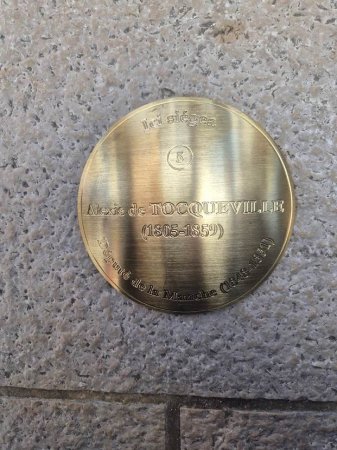
Within this Assembly, Tocqueville embodied a distinctive voice: that of a demanding defender of liberty, convinced that democracy cannot be fully achieved without equality of rights. As rapporteur of the commission on the abolition of slavery, he believed that political freedom only has meaning if it extends to all.
The Tocqueville Foundation welcomes this official recognition. Seeing Tocqueville’s name inscribed in the stone of the Palais Bourbon, alongside other major figures of 1848, is a reminder that his thought remains profoundly relevant for understanding today’s democratic challenges and defending liberty in our time.
The Tocqueville Foundation welcomes this official recognition. Seeing Tocqueville’s name inscribed in the stone of the Palais Bourbon, alongside other major figures of 1848, is a reminder that his thought remains profoundly relevant for understanding today’s democratic challenges and defending liberty in our time.
